• Skip to main content
  • Skip to footer
  • Pacific Mobility Center Stairlifts and More - We Keep You Moving!
  • We Keep You Moving!
  • Call Us Today!
  • 760-471-8884
  • 866-786-2966

Pacific Mobility Center

Stairlifts - Lifts - Mobility Products

  • Stairlifts
    • Bruno Elan Stairlift
    • Bruno Elite – Curved Rail Stairlifts
    • Bruno Elite – Straight Rail Stairlift
    • Bruno Outdoor Curved Stairlifts
    • Bruno Outdoor Straight Stairlifts
    • Stairlift Rentals
  • Products
  • Gallery
    • Photo Gallery
    • Video Gallery
  • FAQ
  • About
    • About Us
    • Contact
    • Locations
    • Service Area
    • Testimonials
    • Reviews
    • Newsletter Subscription and Archives
  • Coupons
  • Blog

mobility

Going Up and Coming Down

December 29, 2014 By Jeff Conner

A recent news article tells a touching story about an elderly mother and her only daughter. The older woman lives in a second floor apartment and the daughter, some miles away. Anna, the mom, is a frail Alzheimer’s patient who cannot navigate the stairs to come down to the ground floor. The daughter, Michelle, suffers from multiple sclerosis and is wheelchair-bound. She can’t climb up the stairs to visit her mother. They can still chat on the phone, but they can’t hold hands or talk face to face.

How different life could be for these two women if there was a permanent and safe way for one to go up – or the other to come down. How sad that illness and incapacitation has become such a barrier to their need to spend time together. The story is a poignant reminder that, for some, even a short flight of stairs can be a distance greater than miles.

In the case of these two loving relatives there was a happy, if all too brief, ending to the story, when a local charitable organization paid for one ambulette visit, so that Michelle, who had to be carried upstairs in her wheelchair by two strong men, could spend a few hours with her mom. The bad news, of course, was that it was a one-time only event.

Options for Going Up and Coming Down

The good news is that, for many others who face a similar challenge of going up and coming down in their own homes, there are options that can bridge the distance between floors. They include: stairlifts, platform lifts and elevators. Depending on your needs, your physical condition, your home layout, and your budget, one of these devices may be the answer to your in-home mobility problems.

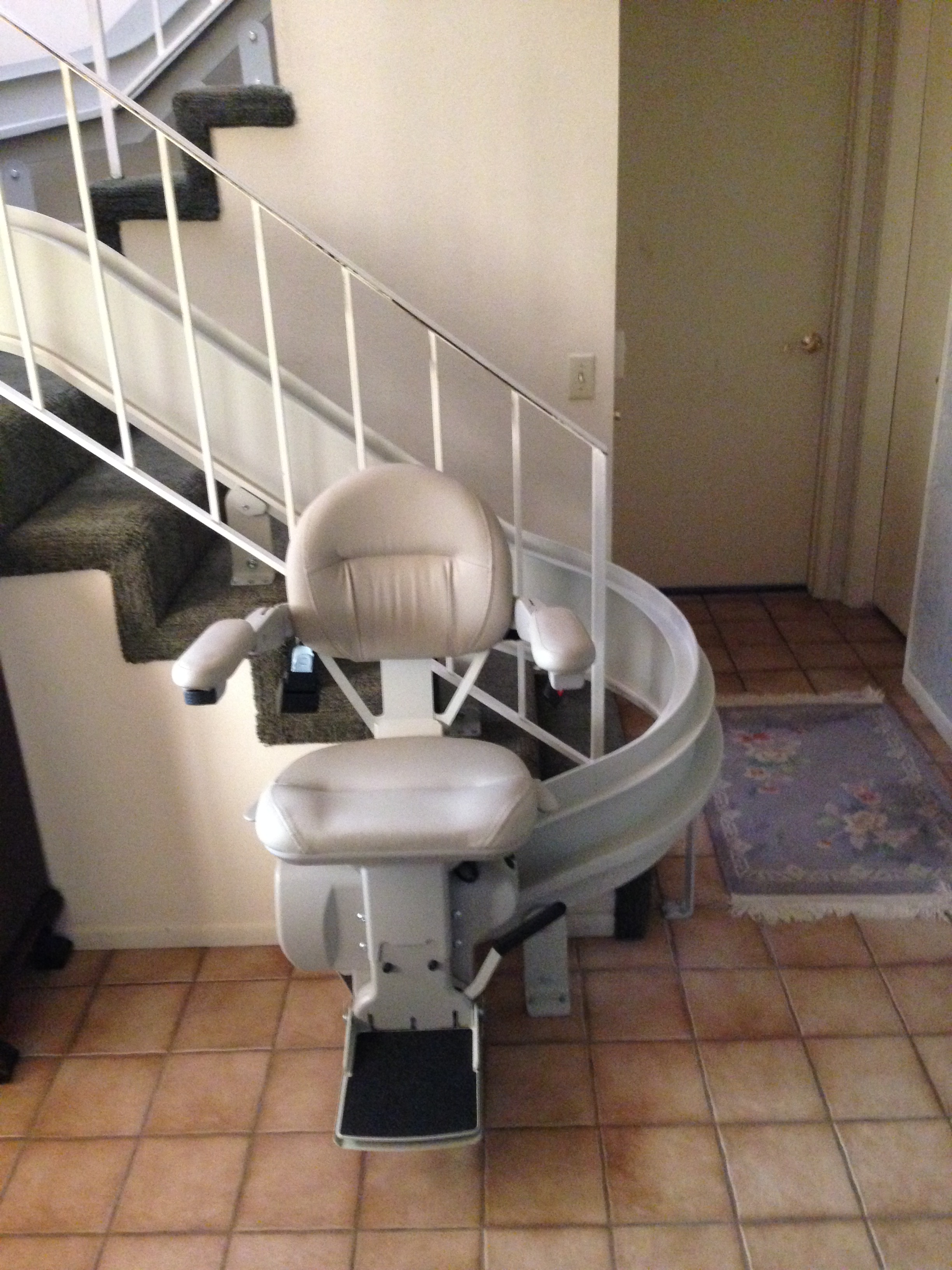
stairlifts – A stairlift is essentially a seat that is attached to a rail or track which is attached to the stairs, themselves, or the wall beside them. It is a good option for a person who can walk, but cannot manage ascending or descending stairs, for any reason. It’s the least expensive option, with the cost of buying and installing one, around $3,000 to $4,000 (more, of course, if the staircase is longer than usual or curved.) It requires that least amount of home modification, but it is not always suitable for people with advanced mobility needs.

Wheelchair Platform Lifts – There are two basic types of wheelchair lifts: inclined and vertical. An inclined wheelchair lift is similar to a chair lift, except that instead of a chair attached to the stair glide, there is a platform that can accommodate a wheelchair. Because it is bigger than a chair lift, it requires more space – a staircase that is, at least, 36 inches wide. It’s also slightly more expensive than a regular chair lift due to its enhanced load capacity.

A vertical wheelchair platform lift is like a small elevator, in that it goes straight up and down. It can be designed to take its user from one floor to another or just a few feet – wherever an inclined wheelchair lift is unsuitable. Unlike an elevator, it doesn’t have a shaft, so it doesn’t require a major home renovation. Platform lifts cost from $3,500 to $5,500 plus installation.

Elevators – An in-home elevator is the most versatile alternative for someone who needs to travel between floors in a wheelchair, and may also want the ability to carry other objects such as medical equipment, or be accompanied by another rider. Because it’s enclosed, it’s also the most aesthetically pleasing among all the options.

However, an elevator is also the most expensive choice and can run between $15,000 and $20,000, when you factor in the cost of the unit, itself, and the necessary structural renovations to your home. It is only an option in a building that has adequate space for a shaft and the requisite machinery to run it.

Consider the Alternatives

Before deciding on the best option, you need to consider all of the alternatives, and then choose the option that fits your needs, your home, and your budget. At Pacific Mobility Center, we can help you make the most appropriate choice for you and your loved ones. It’s part of our promise to “Keep You Moving.”

Jeff Conner
Jeff Conner

President, Husband, Father, Grandfather Graduate of UC Davis- Bio Sci Major- Go Aggies! Jeff has extensive experience in all of Pacific Mobility’s products and services, and specializes in accessibility products as well as stairlifts, ceiling lifts and custom wheel chairs. His hobbies include spending time with family, gardening, mountain biking, exercising and off road motorcycle riding.

24 years as Owner/President of Pacific Mobility Center – selling, installing, and servicing stairlifts, porch lifts, ceiling lifts, pool lifts, handicap ramping, specialty wheelchairs, scooters, power wheel chairs, and other power mobility devices
Certified Environmental Access Consultant since 2008
Licensed General Contractor since 1998
Certified Aging in Place Specialist since 2016
Board Member for Home Access Professionals
Member of Association of Members of the Accessibility Equipment Industry (AEMA)

www.linkedin.com/in/jeff-conner-14085616/

Filed Under: Blog Posts Tagged With: elevator, mobility, stairlift, wheelchair

Deciding if Your Mobility Issues Warrant Leaving Your Home

September 15, 2014 By Jeff Conner

When a person first develops mobility issues, they and their family are often faced with a tough decision. Should they remain in their own home or move into an assisted-care facility? Unless the person with mobility issues already lives in a house equipped with mobility aides, to stay in their own home, it must be properly equipped for their safety. While this process costs money, assisted-living facilities are often also expensive. Making a proper price comparison takes a thorough analysis of the costs involved with both. While this analysis can be tricky, using this easy, step-by-step guide will simplify the process and allow a decision to be made with confidence.

      1. Determine the Assistance Needs of the Person

        Mobility challenges, like the people who experience them, are unique and vary widely. Some people may be able to navigate most of the house safely, but need safety devices in the bathrooms. Other people may need the full-time use of a powerchair. Many will fall somewhere in between these extremes. Knowing what the person requires to overcome their mobility challenges allows a proper assessment to be made of the house and the equipment it needs.

      2. Determine What Equipment the House Needs

        Like people, houses are unique. Each house needs an assessment to be made of its unique requirements. Does it have a staircase? Are the doors wide enough to permit wheelchairs? Is there a large drop from the front door to the stoop? Additionally, not all areas of the house may need to be made accessible. For instance, if the house has a pool, but that pool is rarely used or unlikely to be used for a long period, a pool lift may not be necessary. Consequently, this may mean the back patio also wouldn’t need to be made accessible. Examine the house with an eye towards determining what to areas the person needs access and what challenges the person faces when accessing these areas.

      3. Get Quotes

        Once a comprehensive list of what changes to the house are needed, a proper quote can be obtained. A reputable mobility company will offer free quotes, and a knowledgeable company will be able to suggest an array solutions to many issues. For instance, a short flight of front steps may be made accessible with either a ramp or a porch lift. A good company will walk you through the pros and cons of each solution, along with the price of each, and ensure you feel comfortable with the equipment selected. Remember that prices for these products are usually negotiable. Shop around to make sure you are getting the lowest price in the area.

        This is also the time to determine the cost of an assisted living facility. Visit a range of facilities, and if possible, visit each multiple times at different times of the day and week. Visit unannounced if possible. This will provide a more comprehensive and accurate view of what the facility is like. Once a few viable candidates are determined, get quotes on prices. Remember, these prices are often negotiable. Determine what the realistic costs of the facility will be.

      4. Compare Prices

        With good quotes for both an assisted-living facility and for equipping the home, a fair comparison can be made. One important factor in this comparison is examining the out-of-pocket costs associated with both options. The amount Medicare and private insurance will pay towards both these options will vary, so be sure out-of-pocket costs are being used for comparison. A reputable mobility products company will help you determine these costs for outfitting your home, and a reputable assisted living facility will likewise determine what your share of the cost will be.

One final thing to keep in mind when making a decision, however, are the intangibles of each option. Family members may feel safer knowing a person is at a facility where additional, around-the-clock care is available. On the other hand, staying in the home is an option many prefer because of both sentiment and ease. After all, moving into an assisted living facility requires going through the expensive, burdensome, and time-consuming process of sorting and packing belongings, and often requires downsizing those possessions. Assisted living also lacks the happy memories and comfort of living in one’s own home.

At Pacific Mobility Center, we are happy to help throughout this process. We give free quotes and our trained staff offer expert advice when determining what equipment is needed for a home. We also offer the lowest prices anywhere in the San Diego area.

If you or a loved one is faced with the difficult decision of whether to refit your home for enhanced mobility and safety or move into an assisted-living facility, think of us first. We will walk you through the process of determining what equipment is needed, and give you the confidence that comes from knowing your quote is the lowest in town. If you decide staying in the home is the best option, our certified and licensed techs will install the needed equipment quickly and properly, making the entire process from beginning to end a breeze. Don’t face this difficult decision alone. Come in or contact us today.

The founder of angieslist.com discusses making a home accessible in this short video:

Jeff Conner
Jeff Conner

President, Husband, Father, Grandfather Graduate of UC Davis- Bio Sci Major- Go Aggies! Jeff has extensive experience in all of Pacific Mobility’s products and services, and specializes in accessibility products as well as stairlifts, ceiling lifts and custom wheel chairs. His hobbies include spending time with family, gardening, mountain biking, exercising and off road motorcycle riding.

24 years as Owner/President of Pacific Mobility Center – selling, installing, and servicing stairlifts, porch lifts, ceiling lifts, pool lifts, handicap ramping, specialty wheelchairs, scooters, power wheel chairs, and other power mobility devices
Certified Environmental Access Consultant since 2008
Licensed General Contractor since 1998
Certified Aging in Place Specialist since 2016
Board Member for Home Access Professionals
Member of Association of Members of the Accessibility Equipment Industry (AEMA)

www.linkedin.com/in/jeff-conner-14085616/

Filed Under: Blog Posts, How To's Tagged With: Assisted Living, bathroom, Home, Lifts, mobility, Ramps, Renovation

5 Must-Have Mobility Products for San Diego Summers

July 14, 2014 By Jeff Conner

Summer is here in full force. It’s a great time of year to get outside, be active, and enjoy nature. Unfortunately, many who struggle with mobility allow these challenges to prevent them from enjoying summer the way it was meant to be enjoyed. Here at Pacific Mobility Center, we have a surprisingly wide array of products designed to help you get out there and claim your independence.


Scooters and Powerchairspursuit

Scooters and powerchairs are both designed to give users who need powered mobility assistance with a reliable way to get around. We’ve covered the difference between them in more detail here, but suffice it to say that scooters tend to be better outdoors and for users who don’t always need the use of a chair, while powerchairs are better in tight confines or for users who use a chair full time. Either way, being able to go on summer adventures with confidence is the first step to actually having those exciting times all season.

Vehicle Controlshand control

The road trip is a staple of summer, but sometimes mobility issues make controlling a car difficult or frightening. Regain your confidence and control with our wide array of vehicle controls designed to make driving possible and safe again. Our installation technicians are factory trained and have the skills to quickly install the correct controls for your car and we have demo models available in our showroom. BONUS: Don’t forget the turning seats and vehicle lifts to get you and your equipment into and out of your car in safety with ease.

Porch and stairliftsporch lift

Summer is a great time to sit out on the porch or patio and enjoy the weather while sipping an ice cold beverage. Reclaim all those wonderful outdoor places of your home that have lain unused and neglected through the cold winter months with our line of porch lifts and stairlifts, designed to help you regain access to those areas of your home that were previously too dangerous or difficult to manage. BONUS: For a limited time, get $200 off the installation of a new Bruno stairlift!

Pool Liftspool lift

It’s so hot, and the pool looks inviting. Being in the water is much easier on the joints, and swimming is also great exercise. Unfortunately, getting into and out of a pool may be difficult or dangerous for some with mobility trouble. Good news: our line of pool lifts are designed to help you get into and out of your pool or hot tub safely and confidently. With our pool lifts, you can finally partake again in that most quintessential summer activity, swimming. Start enjoying your pool again with a pool lift.

Grab Barsgrab bars

After all that hot, sweaty, relaxing summer fun, nothing hits the spot like a shower. For those with mobility issues, however, the bathroom is the most dangerous area of the home. 85 percent of falls seniors experience take place in the bathroom. Grab bars help those with mobility issues regain their safety and dignity in the bathroom by providing a safe place to lift, lower, and steady yourself. BONUS: For a limited time, buy three grab bars and get a fourth free.


At Pacific Mobility Center, we want summer fun to be yours again. Our locally owned and operated business has nearly 20 years of experience getting residents of San Diego and Orange County the mobility products they need, with the most knowledgeable and friendly sales staff and the lowest prices, guaranteed. We also offer rentals and demo models so you can try before you buy, and free quotes from our licensed and certified installers once we find you a product you love. So, if you’re ready to take the plunge and make this summer the summer you regained your independence and freedom, contact us today. You’ll be glad you did.

See our porchlifts in action:

Jeff Conner
Jeff Conner

President, Husband, Father, Grandfather Graduate of UC Davis- Bio Sci Major- Go Aggies! Jeff has extensive experience in all of Pacific Mobility’s products and services, and specializes in accessibility products as well as stairlifts, ceiling lifts and custom wheel chairs. His hobbies include spending time with family, gardening, mountain biking, exercising and off road motorcycle riding.

24 years as Owner/President of Pacific Mobility Center – selling, installing, and servicing stairlifts, porch lifts, ceiling lifts, pool lifts, handicap ramping, specialty wheelchairs, scooters, power wheel chairs, and other power mobility devices
Certified Environmental Access Consultant since 2008
Licensed General Contractor since 1998
Certified Aging in Place Specialist since 2016
Board Member for Home Access Professionals
Member of Association of Members of the Accessibility Equipment Industry (AEMA)

www.linkedin.com/in/jeff-conner-14085616/

Filed Under: Blog Posts, Product Information Tagged With: deals, fun, grab bars, mobility, pool lifts, porch lifts, powerchair, San Diego, scooter, stairlifts, summer, turning seats, vehicle controls, vehicle lifts

Don’t Let Mobility Keep You From Voting!

August 20, 2012 By Jeff Conner

New laws passed in many states requiring voters to present valid state or federal identification are bringing back to light a subject often overlooked in the modern American political landscape: disabled voter disenfranchisement. As many as 37 states have passed or are considering voted ID legislation, which could potentially affect, amongst other groups, disabled and elderly voters disproportionately. Disabled and elderly voters are less likely to have ID, and would be prevented from voting under the new or proposed laws. There are also other alarming trends.
A recent study by Rutgers University reveals disabled and elderly voters were disproportionately less likely to vote, a new article by NBC reports. According to the study, disabled and elderly voters were 7% less likely to vote than other groups of voters. The reason? In short, mobility. The study reports that despite court rulings, less than 33% of polling places were completely obstruction-free.
How is this possible in modern America? How can a federal court order be so blatantly flouted? One way state and local governments dodge the order is by allowing absentee ballots and curbside voting. Absentee ballots are ballots mailed in by the voter ahead of the election date. Curbside voting involves mobility-challenged voters staying in their cars while poll workers bring their ballot out to them and assist them in voting. Both of these methods, however, have drawbacks.
Many disabled voters feel that while these options are convenient, some feel they are poor substitutes for voters who want to vote traditionally. Absentee ballots must be mailed well ahead of election dates to ensure they are valid, and hence voters may miss the opportunity to change their planned vote at the last minute due to late breaking developments with a particular party or candidate. In addition, absentee ballots are often not counted unless the race is close. With approximately 11% of voters currently disabled and as many as 36% of voters of 65 disabled, this can lead to the disenfranchisement of a large segment of the population. Voters 65 and older alone comprise 17% of registered voters. Curbside voting is usually counted in the regular vote, but can sometimes lead voters to feel embarrassed or as if they are burdening overworked poll workers. This can lead many disabled voters to avoid using it where available, leading to a drop in the number of disabled people casting ballots.
“People with disabilities should have the same options as everyone else has,” Lisa Schur, a Rutgers University associate professor, said in the article. “Voting in a polling place is an important and symbolic ritual.” Do you feel the same, but are having trouble with your mobility or having trouble accessing your polling place? Pacific Mobility Solutions is here to help.

How Can Pacific Mobility Solutions Help You?

If you are disabled and/or suffering mobility difficulties, please come and see us or call us at (760) 471-8884 to schedule an appointment or drop on in to take a free test drive one of our powerchairs and to find out more about having your vehicle equipped. Many of our powerchairs are capable of negotiating many of the obstacles you may find in real-world situations such as polling places. We’d love to help you find the right one for you, and we can even help you with the Medicare paperwork. We also rent powerchairs and scooters. Come see us today!

Jeff Conner
Jeff Conner

President, Husband, Father, Grandfather Graduate of UC Davis- Bio Sci Major- Go Aggies! Jeff has extensive experience in all of Pacific Mobility’s products and services, and specializes in accessibility products as well as stairlifts, ceiling lifts and custom wheel chairs. His hobbies include spending time with family, gardening, mountain biking, exercising and off road motorcycle riding.

24 years as Owner/President of Pacific Mobility Center – selling, installing, and servicing stairlifts, porch lifts, ceiling lifts, pool lifts, handicap ramping, specialty wheelchairs, scooters, power wheel chairs, and other power mobility devices
Certified Environmental Access Consultant since 2008
Licensed General Contractor since 1998
Certified Aging in Place Specialist since 2016
Board Member for Home Access Professionals
Member of Association of Members of the Accessibility Equipment Industry (AEMA)

www.linkedin.com/in/jeff-conner-14085616/

Filed Under: News and Views Tagged With: disability, disabled, elderly, mobility, news, powerchairs, scooters, voting

Questions and Answers About Medicare Coverage of a Powerchair or Scooter

August 10, 2012 By Jeff Conner

Many people are confused about whether their Medicare benefit will cover their powerchair or scooter, how they can qualify for such coverage, and what that coverage will be. In this article, we will attempt to answer some of the frequently asked questions regarding this issue with clear, no-nonsense answers. Hopefully, by the end we will have addressed any concerns or questions you personally may have, but if we haven’t, please feel free to contact us at (760) 471-8884 and we will be happy to assist you! At Pacific Mobility Solutions, we are a family owned and local business and we value our customers’ satisfaction. In fact, we guarantee it!

What are the Requirements for Medicare Coverage?

In Medicare terminology, a scooter, powerchair, or manual wheelchair is referred to as “Mobility Assistive Equipment”. There are several different categories: Manual Chair, Rolling Chair, Power Scooter, and Power Wheelchair. Each category has different requirements, but before we get into that, let’s first address the common requirements for all categories.

To qualify for any of the categories, you must meet all the following conditions:

First, you must have a medical/health condition that prevents you from moving without difficulty inside your home. Second, you must be unable to perform normal living activities such as dressing, bathing, getting in or out of chairs or other furniture, even with the aid of a crutch, cane, or walker. Third, you must either be able to safely operate the equipment yourself or have someone who is always available to assist you in the usage of the equipment. The equipment must also fit and be able to be operated safely inside your home, but at Pacific Mobility Solutions we offer a broad array of options and accessibility accessories such as ramps and stairlifts, so we can help with this issue. Finally, it’s important to note that unfortunately you will only qualify for the benefit if the equipment is needed inside your home, and not purely for outside-the-home movement or recreational purposes. Now let’s discuss the individual category requirements and definitions.

Manual Wheelchairs are regular, non-powered wheel chairs with large rear wheels and smaller front wheels. You may qualify for a manual wheelchair if you can’t use a cane or walker safely. Not all manual wheelchairs qualify for this benefit. Please contact us at (760) 471-8884 for assistance choosing one that is covered. We will be happy to help!

Rolling Chairs are non-powered chairs that offer more support and comfort. Their rear wheels are smaller but at least 5” in diameter. You may qualify for one of these if you medically require more support than is provided by a manual wheelchair. The chair must be designed to meet your particular medical need or condition.

Power Scooters are three- or four-wheeled powered vehicles with a chair that generally are controlled with handlebars much like a bicycle. You may qualify for a power scooter if you cannot use a cane, walker, or crutches safely and are unable to operate a manual wheelchair.

Power Wheelchairs, or Powerchairs are generally chairs mounted on four or six wheels that are controlled by a joystick and have the ability to turn in small or zero radius. You may qualify for a powerchair if you cannot sit up or operate the scooter controls safely, or if you cannot safely use a manual wheelchair in your home.

For all categories, you must have your doctor verify your medical need for the equipment. In the case of power equipment, your doctor must examine you in person and verify that you have the ability to operate the equipment safely. Your doctor must then submit an order to Medicare verifying and explaining your need for the equipment and your ability to use it safely.

Once this has been determined, the next question you may have is how much of the cost of the equipment Medicare will cover.

What Share of the Cost Will Medicare Cover?

This is a very common question and concern shared by many people. Mobility Assisitive Equipment is covered under Medicare Part B. Generally, once you have met your Part B deductible, Medicare will cover 80% of the Medicare-approved cost, leaving 20% for you to cover. If you have private insurance, it may cover part or all of the 20%, meaning you may be able to get the equipment for little or no cost. You should contact your insurance provider for more information regarding their coverage. It is important to note that at Pacific Mobility Solutions we offer the widest selection and lowest prices, guaranteed. We can work with many budgets and needs are always willing to help you. Also, Pacific Mobility Solutions is a Medicare-participating supplier, which means we are approved by Medicare to supply your mobility needs. Now you are ready to pick out your equipment.

How Do I Know What Chair is Right for Me?

At Pacific Mobility Solutions, we offer a broad range of equipment from manual chairs all the way up to top of the line, state of the art powerchairs. We know knowing which category of equipment you qualify for and which model is right for you can be confusing. That’s why we are here to help. We offer many floor models for testing with free test rides, and our friendly, knowledgeable, and factory-trained staff are always available to assist you in carefully choosing the right chair for you. We will help work with your doctor and Medicare to determine what type of equipment you qualify for, and which model will best suit your needs and budget. Please contact us at (760) 471-8884 with any questions you may have, to schedule an appointment, or just drop on by. At Pacific Mobility Solutions, we are your locally and family owned and operated , Medicare approved source for all your mobility needs. Please come see us to experience what a difference personalized service, friendly and knowledgeable staff, and that family touch can make for your sales and service experience.

Still on the fence? We also rent a variety of equipment including manual chairs, power chairs, and travel scooters. You may be able to rent the equipment first before you buy to try it out for a longer period.

Hopefully this has answered your questions and addressed any concerns you may have. If not, for more information, or to schedule an appointment, please call us at (760) 471-8884. At Pacific Mobility Solutions, we put our customers first and guarantee satisfaction 100%. Call or come in today reclaim your mobility!

This information is being provided for informative use only and should not be considered medical or legal advice. For medical or legal questions, please contact your doctor or attorney. For more info about Medicare’s benfits and requirements, please refer to www.medicare.gov and specifically http://www.medicare.gov/Publications/Pubs/pdf/11046.pdf
Jeff Conner
Jeff Conner

President, Husband, Father, Grandfather Graduate of UC Davis- Bio Sci Major- Go Aggies! Jeff has extensive experience in all of Pacific Mobility’s products and services, and specializes in accessibility products as well as stairlifts, ceiling lifts and custom wheel chairs. His hobbies include spending time with family, gardening, mountain biking, exercising and off road motorcycle riding.

24 years as Owner/President of Pacific Mobility Center – selling, installing, and servicing stairlifts, porch lifts, ceiling lifts, pool lifts, handicap ramping, specialty wheelchairs, scooters, power wheel chairs, and other power mobility devices
Certified Environmental Access Consultant since 2008
Licensed General Contractor since 1998
Certified Aging in Place Specialist since 2016
Board Member for Home Access Professionals
Member of Association of Members of the Accessibility Equipment Industry (AEMA)

www.linkedin.com/in/jeff-conner-14085616/

Filed Under: Product Information Tagged With: answers, benefit, coverage, manual wheelchair, medicaid, medicare, mobility, mobility assistive equipment, mobility assitance, power scooter, power wheelchair, powerchair, questions, rolling chair, scooter, wheelchair

  • « Go to Previous Page
  • Page 1
  • Interim pages omitted …
  • Page 6
  • Page 7
  • Page 8

Footer

San Diego County Showroom

1355 Grand Ave Suite 102
San Marcos, CA 92078
Toll Free: 866-786-2966
Local: 760-471-8884

Riverside County Lift Sales

Pacific Mobility Center of Temecula
Toll Free: 866-786-2966
Local: 951-383-6845

Orange County Lift Sales

Pacific Mobility Center of Huntington Beach
Toll Free: 866-786-2966
Local: 714-907-4005

Office Hours

Monday-Thursday: 9:00am-5:00pm (closed 12:00-1:15 for lunch)

Friday: 8:30am-4:30pm (closed 12:00-1:15 for lunch)

Find Us on Social Media

Facebook Yelp BBB Angies List Twitter LinkedIn

Showroom Location


View Larger Map

  • Home
  • Coupons
  • Quote Request
  • About Us
  • Products
  • Careers
  • Blog
  • Gallery
  • FAQ
  • Contact
  • Service Area
  • Privacy Policy
  • Terms of Service
  • Disclaimer
  • Cookie Policy
  • Proposition 65 Warnings

Copyright © 2026 Pacific Mobility, All Rights Reserved.


Website by A Servant's Heart Web Design and Marketing

Schedule an Appointment

How can we help you?