• Skip to main content
  • Skip to footer
  • Pacific Mobility Center Stairlifts and More - We Keep You Moving!
  • We Keep You Moving!
  • Call Us Today!
  • 760-471-8884
  • 866-786-2966

Pacific Mobility Center

Stairlifts - Lifts - Mobility Products

  • Stairlifts
    • Bruno Elan Stairlift
    • Bruno Elite – Curved Rail Stairlifts
    • Bruno Elite – Straight Rail Stairlift
    • Bruno Outdoor Curved Stairlifts
    • Bruno Outdoor Straight Stairlifts
    • Stairlift Rentals
  • Products
  • Gallery
    • Photo Gallery
    • Video Gallery
  • FAQ
  • About
    • About Us
    • Contact
    • Locations
    • Service Area
    • Testimonials
    • Reviews
    • Newsletter Subscription and Archives
  • Coupons
  • Blog

mobility assistive equipment

Driving Adaptations

December 1, 2015 By Jeff Conner

In this day and age, travelingby automobile is virtually a necessity for the majority of American adults. Most of us use our cars daily to commute to and from work, to go shopping and complete other chores, to chauffeur our children to their activities, to visit our friends and family members, or merely to get away for relaxation or vacation.

And the good news is that modern technology has offered people with physical impairments, who might not believe they can navigate a car safely, the opportunity to remain independent and mobile. Almost every automobile manufacturer, as well as a vast number of after-market product suppliers, has created a wide variety of automobile adaptations that can place almost every impaired, disabled, or mobility-challenged adult behind the wheel and on the road.

For example, pedal adaptations are available for individuals who have lost the use of their right leg and cannot utilize the standard accelerator. Left foot accelerators can be fitted to the left of the brake so that accelerating with the left foot becomes possible. For individuals who cannot reach the pedals at all when driving, pedal extenders can bring them closer to the driving seat.

For individuals who have lost the use of both legs, there are many ways in which a car’s traditional pedal functions – braking and accelerating – can be accomplished with hand controls. Push-pull hand controls allow the driver to operate the brake and accelerator functions by pushing and pulling a lever. There are various hand controls available from most manufacturers and suppliers, but the basic function is the same across most models. They range from more basic mechanical push/pull systems to electronic or air compression systems. Most can be fitted with “cutting” devices which automatically cut the accelerator when the brake is applied. And some can even be mounted on different locations inside the car. Some variations of the electronic hand control system include:

• The Trigger Accelerator – With a trigger accelerator you pull with your finger to accelerate, and push away to brake.
• The Over Ring Accelerator – The over ring accelerator is fitted in front of the steering wheel. You push it down toward the steering wheel to accelerate.
• The Under Ring Accelerator – The under ring accelerator is fitted behind the steering wheel. You pull it towards the steering wheel to accelerate.
• The Ghost Ring Accelerator – The ghost ring accelerator is fitted behind the steering wheel. You control the speed by using your fingers in side to side movements.
• The Twist Grip Accelerator – The twist grip accelerator is comparable to the hand grip accelerator on a motorbike. You twist it to accelerate and push it forward to operate the brake.

The bottom line is this: there is absolutely no reason for a disabled, but otherwise competent, adult to believe that he or she cannot safely operate an automobile. Here at Pacific Mobility, we can help you choose the most appropriate driving adaptation to meet your needs. Call or visit us today and allow our mobility experts to get you into the driver’s seat.

Jeff Conner
Jeff Conner

President, Husband, Father, Grandfather Graduate of UC Davis- Bio Sci Major- Go Aggies! Jeff has extensive experience in all of Pacific Mobility’s products and services, and specializes in accessibility products as well as stairlifts, ceiling lifts and custom wheel chairs. His hobbies include spending time with family, gardening, mountain biking, exercising and off road motorcycle riding.

24 years as Owner/President of Pacific Mobility Center – selling, installing, and servicing stairlifts, porch lifts, ceiling lifts, pool lifts, handicap ramping, specialty wheelchairs, scooters, power wheel chairs, and other power mobility devices
Certified Environmental Access Consultant since 2008
Licensed General Contractor since 1998
Certified Aging in Place Specialist since 2016
Board Member for Home Access Professionals
Member of Association of Members of the Accessibility Equipment Industry (AEMA)

www.linkedin.com/in/jeff-conner-14085616/

Filed Under: Blog Posts Tagged With: auto hand controls, driving, driving aids, mobility, mobility assistive equipment, mobility challenged, mobility impaired, safety

Swimming Pool Lifts

November 10, 2015 By Jeff Conner

pool lift

Swimming is great exercise as well a great way to relax. And spending time in a swimming pool can be very therapeutic for most people. However, for individuals with certain disabilities or mobility challenges, getting in and out of a pool can be very difficult, or even impossible without some type of aid. Fortunately, over the years, there have been many in almost any situation.

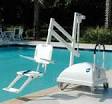
Basically, a pool lift is any mechanized seat with the ability to lower and raise a disabled or injured person into and out of a swimming pool. Pool lifts can either be permanent or portable. Permanent pool lifts can be installed on the edge of a pool, or onto an anchor embedded in the pool deck, while portable lifts, which usually have wheel attachments, can be placed anywhere around the pool, and then put in storage when not in use.

As with any type of product, different types of pool lifts have their own advantages and disadvantages. For example, permanent pool lifts are preferable in instances where the individuals needing them are heavier than normal, but, unlike portable lifts, they are always open to the elements.

The first commercially successful water-powered, swimming pool lift hit the market around 1980. By 1997, manufacturers had perfected a battery-powered, free-standing pool lift that was designed to work with more contemporary swimming pool designs. All types of patient lift systems, including pool lifts, are regulated by the U.S. Food and Drug Administration and must meet certain standards in their design and manufacture.

Swimming pool lifts can be categorized as follows: • Non –cantilevered lifts have seats that are attached to and rotate around an anchor point. Most early lifts were of this type as they are limited to simple pool designs that feature either no gutter of recessed gutters. They are fairly inexpensive and easy to operate, but they must be fixed in place to a deck or anchor and connected to a water supply to power them.
• Cantilevered lifts are designed to allow the seat to extend out from the anchor point. They can be fixed, anchored or free standing. Cantilevered lifts provide access to a greater number of pool designs, including rim-flow gutters, roll out gutters, or any type of design where there is a substantial horizontal distance from the loading point to the water. They are further categorized as non-rotational and rotational: o Non-rotational cantilevered lifts extend the seat directly out from the loading point.
o Rotational cantilevered lifts have the added ability to raise and rotate the seat position over the pool deck and extend it over any obstacle in the path to the water. This type of lift provides the greatest versatility of any of the different designs. They can be anchored or free standing, with free standing models generally the most expensive.

Pool lifts in public pools are regulated by the American with Disabilities Act, and as such, cannot be manually operated, as the law requires that they be capable of unassisted operation. However, manually operated pool lifts can be used in a residential setting.

Pacific Mobility has many pool lift options to choose from. We invite you to talk to one of our professional staff members who will help you determine what kind of pool lift best suits your needs and budget. Call us today for a free consultation.

Jeff Conner
Jeff Conner

President, Husband, Father, Grandfather Graduate of UC Davis- Bio Sci Major- Go Aggies! Jeff has extensive experience in all of Pacific Mobility’s products and services, and specializes in accessibility products as well as stairlifts, ceiling lifts and custom wheel chairs. His hobbies include spending time with family, gardening, mountain biking, exercising and off road motorcycle riding.

24 years as Owner/President of Pacific Mobility Center – selling, installing, and servicing stairlifts, porch lifts, ceiling lifts, pool lifts, handicap ramping, specialty wheelchairs, scooters, power wheel chairs, and other power mobility devices
Certified Environmental Access Consultant since 2008
Licensed General Contractor since 1998
Certified Aging in Place Specialist since 2016
Board Member for Home Access Professionals
Member of Association of Members of the Accessibility Equipment Industry (AEMA)

www.linkedin.com/in/jeff-conner-14085616/

Filed Under: Blog Posts, Product Information Tagged With: disability, mobility assistive equipment, mobility challenged, pool lifts

Knee Walker vs. Crutches – Pros and Cons

September 30, 2015 By Jeff Conner

Knee Walker

If you had to choose between using a knee walker versus using crutches after recovering from a broken ankle, foot surgery, or any other operation or injury, you might wish you had the option to choose neither. After all, any assistive mobility device is going to be something that you’re going to have to learn to control and maneuver, not to mention drag around. Of course, choosing neither is an option if you have the time and ability to stay completely off your feet for an extended period of time. However, most people want and need to be able to get around, and the thought of being totally immobilized until well enough to walk unassisted is far from a pleasant thought.

And so, these two devices are really your best choices. Let’s consider their pros and cons:

• Crutches – the Pros: If you have decent upper body strength and mobility, you can usually walk faster with crutches, once you’ve figured out how to use them. Also, walking with crutches will certainly take some work, and there’s nothing wrong with getting some exercise when recuperating from an operation or injury. Also, crutches are fairly inexpensive. You can even rent them from a medical supplier.

• Crutches – the Cons: Crutches can be difficult to maneuver. And because all your weight must be carried on your armpits, you certainly risk irritating them – not to mention the wear and tear on your shoulders, wrists and lower back. Many people with injured legs find crutches too unsteady and unsafe for their use. Also, when your arms and hands are occupied clutching your crutches, you will have more difficulty in using them to open doors, pick things up, etc. Stairs can be particularly difficult to navigate with crutches, especially at the beginning. Finally, crutches are clunky items that are constantly falling over and don’t always fit through doorways, car doors, etc.

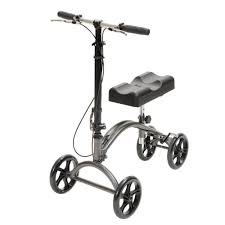
• Knee Walkers – the Pros: Knee walkers, because they are low to the floor are generally more stable than crutches. They are cushioned for comfort with space to let you rest a cast or injured leg, without having to put your weight on it. You can zoom around pretty quickly, once you get the steering figured out, and once you stop, you have both hands free. They are fairly simple to use and don’t require any upper body strength. They are less clunky than crutches and the possibility of slipping on slick or wet surfaces is diminished.

• Knee Walkers – the Cons: Knee walkers can be unstable if you lean back or forward too far or too much to one side. Also, they take a while to learn how to go straight. They are slower going than crutches on many surfaces. You cannot go up or down stairs on a knee walker, and if the front wheel base is too wide, you may not be able to go through narrow doorways or halls. Knee walkers are more expensive than crutches.

At Pacific Mobility, we can help you choose the best option for your post-operative or post-injury recovery. We will only sell you what you need, and within your budget, to help you get back on your feet in the quickest time possible. Call us today for a free consultation.

Jeff Conner
Jeff Conner

President, Husband, Father, Grandfather Graduate of UC Davis- Bio Sci Major- Go Aggies! Jeff has extensive experience in all of Pacific Mobility’s products and services, and specializes in accessibility products as well as stairlifts, ceiling lifts and custom wheel chairs. His hobbies include spending time with family, gardening, mountain biking, exercising and off road motorcycle riding.

24 years as Owner/President of Pacific Mobility Center – selling, installing, and servicing stairlifts, porch lifts, ceiling lifts, pool lifts, handicap ramping, specialty wheelchairs, scooters, power wheel chairs, and other power mobility devices
Certified Environmental Access Consultant since 2008
Licensed General Contractor since 1998
Certified Aging in Place Specialist since 2016
Board Member for Home Access Professionals
Member of Association of Members of the Accessibility Equipment Industry (AEMA)

www.linkedin.com/in/jeff-conner-14085616/

Filed Under: Blog Posts, Product Information Tagged With: crutches, disability, knee walker, mobility assistive equipment, mobility challenged

Patient Lifts

August 28, 2015 By Jeff Conner

patient lift

A patient lift is an assistive device that allows patients in hospitals, nursing homes, or those receiving home health care, who cannot lift themselves, or are otherwise mobility challenged, to be transferred between a bed, a chair, a wheelchair, or a commode. Patient lifts help ensure the safety of both the patient and his or her caregiver.

There are several different types of patient lifts available, including sit-to-stand lifts, which are often on the floor, and sling lifts which can either be floor-based or attached to a ceiling or an overhead track.

The sit-to-stand lift is designed to help patients who have some mobility, but lack the strength to rise to a standing position from a bed, wheelchair, chair, or commode, yet do have the strength both to sit up and to physically support their weight while standing. They are designed to transfer a patient between two seating surfaces. They employ straps, vests, or belts that usually fit under a patient’s arms and utilize hydraulic power to operate, much like a floor-based automobile jack. Sit-to-stand lifts fix a patient’s legs in position while the lift mechanism gradually moves his or her body into a standing position, and then reverses the process when the patient needs to be seated.

The sling lift, sometimes known as a Hoyer Lift, is used to lift a patient entirely off a bed, chair, wheelchair, or commode. It is used for patients who have either no mobility at all or enough strength to support themselves while standing. The use of a sling lift involves placing a piece of fabric that is attached to a series of hooks or clips, under the patient. The sling must be strong enough to hold the weight of the patient while he or she is suspended in air. Patients who cannot withstand being bent or compressed can be lifted via stretcher sling lifts which are used for supine transfer.

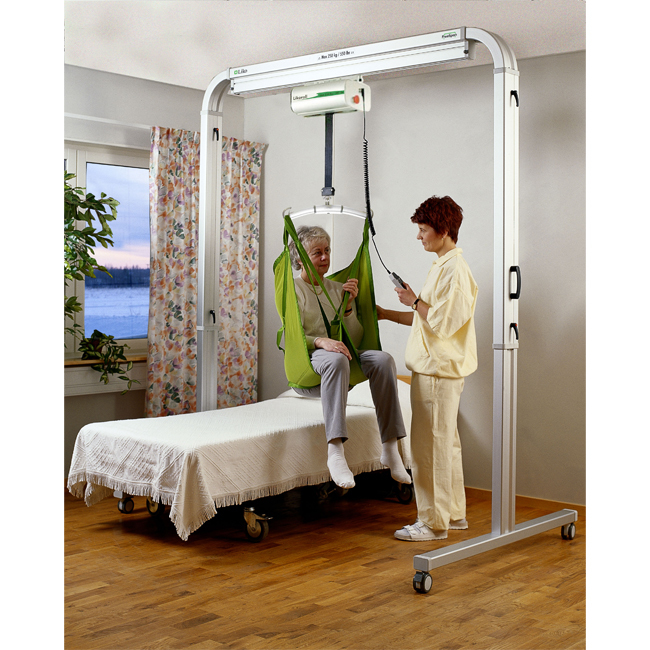
Sling lifts that are permanently installed on the ceiling of a room are called ceiling lifts. Ceiling lifts use the same sling technology as floor sling lifts, with the additional possibility of having a track system attached to the ceiling for the horizontal movement of a patient within his or her room, or into an adjoining room or bathroom. They also free up the floor space that is necessary for a floor lift. Ceiling lifts generally utilize an electric motor to operate their lift mechanism. Sling lifts also come in modular, free-standing styles with overhead track systems similar to those of ceiling lifts. They are less expensive than installed ceiling lifts, and can be moved from room to room as required.

The pressure fit lift is a type of sling lift that provides the function of a typical ceiling lift, without the need for a permanent installation. The overhead track, to which the sling is attached, is mounted between two poles that extend from the floor to the ceiling. This type of lift is ideal for rental situations or wherever a ceiling lift or permanent track installation is not possible or too difficult to mount, safely.

https://www.youtube.com/watch?v=wkKADjwPUKA

Jeff Conner
Jeff Conner

President, Husband, Father, Grandfather Graduate of UC Davis- Bio Sci Major- Go Aggies! Jeff has extensive experience in all of Pacific Mobility’s products and services, and specializes in accessibility products as well as stairlifts, ceiling lifts and custom wheel chairs. His hobbies include spending time with family, gardening, mountain biking, exercising and off road motorcycle riding.

24 years as Owner/President of Pacific Mobility Center – selling, installing, and servicing stairlifts, porch lifts, ceiling lifts, pool lifts, handicap ramping, specialty wheelchairs, scooters, power wheel chairs, and other power mobility devices
Certified Environmental Access Consultant since 2008
Licensed General Contractor since 1998
Certified Aging in Place Specialist since 2016
Board Member for Home Access Professionals
Member of Association of Members of the Accessibility Equipment Industry (AEMA)

www.linkedin.com/in/jeff-conner-14085616/

Filed Under: Blog Posts Tagged With: bathroom, disability, mobility, mobility assistive equipment, mobility assitance, patient lift

Pool Lifts

August 14, 2015 By Jeff Conner

pool lift

In 1990, the American with Disabilities Act (ADA) was signed into law by President George H.W. Bush. The ADA is one of America’s most comprehensive pieces of civil rights legislation in that it guarantees that people with disabilities have the same opportunities as everyone else to participate in the mainstream of American life — to enjoy employment opportunities, to purchase goods and services, and to participate in state and local government programs and services.

Title III of the ADA prohibits discrimination on the basis of disability by places of public accommodation, including many private businesses. It requires newly constructed and altered business facilities to be fully accessible to people with disabilities, applying the ADA Standards for Accessible Design. Facilities that don’t meet the standard may face civil penalties of up to $55,000.

For many years, people with disabilities were excluded from participating in many recreational activities, including swimming. The 2010 ADA Standards required that newly constructed or altered swimming pools, wading pools, and spas have an accessible way for people with disabilities to enter and exit the pool. The Standards also provided technical specifications for when a means of entry is accessible, such as, for pool lifts, the location, size of the seat, lifting capacity, and clear floor space.

In 2012, the U.S. Department of Justice issued guidance titled “ADA 2010 Revised Requirements: Accessible Pools—Accessible Means of Entry and Exit” to assist entities covered by Title III of the ADA, such as hotels and motels, health clubs, recreation centers, public country clubs, and other businesses that have swimming pools, wading pools, and spas, in understanding how the new requirements apply to them.

Large pools (pools with 300 linear feet of pool wall or more) must have two accessible means of entry and exit. One means of entry/exit must be a fixed pool lift or sloped entry; the other entry can be a transfer wall, transfer system, or pool stairs. Small pools (pools with less than 300 linear feet of pool wall) must provide at least one accessible means of entry/exit, which must be either a fixed pool lift or a sloped entry.

A lift, which is essentially an immersible chair affixed to a small crane that’s attached to the pool deck, allows people who are unable to use steps to easily enter and exit a pool. A fixed pool lift is one that is affixed to the pool deck or apron in some fashion. Conversely, a non-fixed lift is not affixed in any way. Many businesses with pools have purchased or own portable (i.e. non-fixed) pool lifts. If that portable lift is affixed to the pool deck, then it could be considered a fixed lift and compliant under the rules. Thus, owners of a portable lift may be able to comply with the ADA requirements by affixing lifts to the pool deck or apron.

Pool lifts are designed by different manufacturers and do vary. One may have a concave seat while another is flat. Some move slightly faster than others, and some can sway a bit during the transfer process. Some lifts may have armrests, a headrest or a seat belt; all are optional accessories. However, ADA guidelines require all pool lifts to have a footrest, a seat measuring at least 16 inches wide, and the ability to support a minimum weight of 300 pounds.

Swimming can be very therapeutic for most folks, with or without disabilities, and private homes with pools can also be fitted with portable or fixed pool lifts which are designed to be independently operated. While private homes do not need to meet the ADA guidelines, it’s still important to recognize which type of lift will work best with different types of pools. For an in-ground pool, a portable or fixed pool lift which can extend downward into the water is likely the best option. For above-ground pools, a pool lift that can extend over and into the pool will allow proper access. Of course, the main priorities, in all cases, are safety and comfort.

If you are interested in finding out more about pool lifts, call or visit us at Pacific Mobility Center. Our trained experts can help you decide the most appropriate pool lift for your pool as well as for your family member with a disability.

Jeff Conner
Jeff Conner

President, Husband, Father, Grandfather Graduate of UC Davis- Bio Sci Major- Go Aggies! Jeff has extensive experience in all of Pacific Mobility’s products and services, and specializes in accessibility products as well as stairlifts, ceiling lifts and custom wheel chairs. His hobbies include spending time with family, gardening, mountain biking, exercising and off road motorcycle riding.

24 years as Owner/President of Pacific Mobility Center – selling, installing, and servicing stairlifts, porch lifts, ceiling lifts, pool lifts, handicap ramping, specialty wheelchairs, scooters, power wheel chairs, and other power mobility devices
Certified Environmental Access Consultant since 2008
Licensed General Contractor since 1998
Certified Aging in Place Specialist since 2016
Board Member for Home Access Professionals
Member of Association of Members of the Accessibility Equipment Industry (AEMA)

www.linkedin.com/in/jeff-conner-14085616/

Filed Under: Blog Posts, News and Views Tagged With: ADA Guidlines, disability, mobility assistive equipment, pool lift

Getting in and Out of a Vehicle

July 10, 2015 By Jeff Conner

amsvans-large-bruno-tas5301-compact-liftup

Many mobility-challenged people still need, or prefer, to be able to travel by car or truck either as a driver or a passenger. Luckily, the art and science of vehicle conversion has come a long way in recent years and these individuals have a wide range of choices when it comes outfitting an automobile, truck, or van with the necessary accommodations.

Picking both the right type of vehicle and the best kind of conversion depends on many factors. Perhaps the most important is determining the nature and extent of someone’s mobility challenges. Some disabled drivers who are able to get around without a wheelchair may also be able to get by with less than a fully-converted, wheelchair-accessible van. For these individuals, simply purchasing a sedan or coupe with a low and accessible seat height may be sufficient.

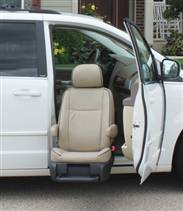
However, individuals with greater mobility challenges should definitely consider a vehicle equipped with seating that allows safe and easy access and egress. Several types are available. A turnout chair provides trouble-free access to vehicles that are lower to the ground. The seat rotates about 90 degrees and slides out a few inches over the doorsill. Once it is occupied it can be moved back to its original interior position for travel. Reversing the procedure allows a driver or passenger to exit the vehicle, safely. A turnout seat can be either manually or electronically controlled.

The next level up in this department is a turnout seat that not only rotates, but also can recline slightly for extra headroom, while it lowers toward the ground, just outside the car. Finally, there are rotating chairs that can come completely out of a vehicle and then lower towards the ground. They, too, can be electronically controlled either with a hand control unit, or power buttons installed within the seat or car door.

Other adaptation options include wheelchair lifts, hand controls, and mechanized lifts, called “curbsiders,” that can be fitted into the rear of a truck or van in order to load or unload a motorized scooter.

Before considering what type of vehicle adaptation is the right one for you, you should always consult an expert in the field. Here at Pacific Mobility we have the experience and expertise to help you select the most appropriate conversion or adaptation for your mobility challenges that will both suit your needs and fit within your budget. Call us today for a free consultation.

https://youtu.be/ajy2TH0b7OY

Jeff Conner
Jeff Conner

President, Husband, Father, Grandfather Graduate of UC Davis- Bio Sci Major- Go Aggies! Jeff has extensive experience in all of Pacific Mobility’s products and services, and specializes in accessibility products as well as stairlifts, ceiling lifts and custom wheel chairs. His hobbies include spending time with family, gardening, mountain biking, exercising and off road motorcycle riding.

24 years as Owner/President of Pacific Mobility Center – selling, installing, and servicing stairlifts, porch lifts, ceiling lifts, pool lifts, handicap ramping, specialty wheelchairs, scooters, power wheel chairs, and other power mobility devices
Certified Environmental Access Consultant since 2008
Licensed General Contractor since 1998
Certified Aging in Place Specialist since 2016
Board Member for Home Access Professionals
Member of Association of Members of the Accessibility Equipment Industry (AEMA)
www.linkedin.com/in/jeff-conner-14085616/

Filed Under: Blog Posts Tagged With: auto hand controls, disability, driving, mobility assistive equipment, mobility challenged

Different Types of stairlifts and Their Benefits

June 24, 2015 By Jeff Conner

Chair-lift

For mobility challenged individuals who need a way to go up and down a flight of stairs in their homes, there are several different types of stairlifts available. The most recognizable type is the straight stairlift that attaches to the stair treads by way of a straight rail on which a chair can glide up and down. These lifts are suitable for those users who can walk, but not climb, and don’t need to transport anything up and down but themselves, and maybe items that can be held on their lap.

The standard variation of the straight stairlift is the curved model that has a rail that can fit the shape of a winding or curved staircase. Both the straight and curved stairlift most commonly have a seat that is either fixed, folds up and down, or swivels toward or away from the wall. The kind of seat installed will depend both on the needs of the user and the space available on the stairs and landings of a particular home.

stairlifts can be operated either by battery or by a home’s electrical system. While batteries will have to be replaced every few years, those running on house current will never need that type of maintenance. On the other hand, electrical lifts won’t work if there is a power failure.

The standing stairlift is a variation of the lift device. It can be used by people who can’t sit but are able to stand. In order for a standing stairlift to operate effectively, there must be enough headroom in the staircase for a standing individual to travel safely. The standing lift is also suitable for homes with very narrow staircases or ones that for some reason can’t accommodate a seated lift.

Platform stairlifts are another variation. They are designed to be large and strong enough to hold a wheelchair, or in some cases, a small or mid-sized scooter. They are appropriate for individuals who can’t transfer from a sitting position in a chair or scooter to a chair in a standard stairlift. They are also ideal for older and disabled people who are wheelchair bound and need to stay in their chairs no matter what floor they are on.

Finally, although not considered a stairlift, per se, the vertical “through floor” lift has a track that can attach to a wall as it traverses through a hole in the ceiling/floor. It is an option for a home that cannot accommodate an ordinary lift, for example, one whose staircase is too narrow or has a spiral shape design.

At Pacific Mobility, we will help you choose the best stairlift option for your home by carefully explaining the benefits of all the different types we offer.

Jeff Conner
Jeff Conner

President, Husband, Father, Grandfather Graduate of UC Davis- Bio Sci Major- Go Aggies! Jeff has extensive experience in all of Pacific Mobility’s products and services, and specializes in accessibility products as well as stairlifts, ceiling lifts and custom wheel chairs. His hobbies include spending time with family, gardening, mountain biking, exercising and off road motorcycle riding.

24 years as Owner/President of Pacific Mobility Center – selling, installing, and servicing stairlifts, porch lifts, ceiling lifts, pool lifts, handicap ramping, specialty wheelchairs, scooters, power wheel chairs, and other power mobility devices
Certified Environmental Access Consultant since 2008
Licensed General Contractor since 1998
Certified Aging in Place Specialist since 2016
Board Member for Home Access Professionals
Member of Association of Members of the Accessibility Equipment Industry (AEMA)
www.linkedin.com/in/jeff-conner-14085616/

Filed Under: Blog Posts, Product Information, Uncategorized Tagged With: mobility, mobility assistive equipment, stairlift, wheelchair

Ramping vs. Porchlift

June 10, 2015 By Jeff Conner

If you need to facilitate wheelchair or handicap access to a home or structure that has a raised foundation, and stairs are not a viable option, essentially, you have two other choices: you can install either a ramp or a porch lift.                                                                                                  ramp     Porch Lift

In order to figure out if a ramp is a practical alternative, you’re going to have to do a lot of measuring and then perform some simple arithmetic. The first thing you need to determine is the extent of the rise between the ground and the structure’s entry level. In other words, what is the “rise?” Once you know the rise, then you can calculate how much ramping will be required.

According to the federal government’s Americans with Disabilities Act, the legal standard for the ratio of rise to ramping in public buildings is 1:12. In other words, for every inch of rise, the law requires twelve inches, or one foot, of ramping. Now, your home is not a public building and some municipal or county building codes might be more lenient requiring only, perhaps, 8 inches of ramping for every 1 inch of rise, so it’s important to check with your local government, if you need to build a steeper ramp. But the ADA ratio is considered the safest solution.

So, for example, if the rise between the ground and the entry level is 30 inches, you’re generally going to need 30 feet of ramping. Now that you know how many linear feet of ramping is necessary either for code or safety requirements, you’re going to have to measure again, this time to determine if you have 30 feet of room in which to put a ramp. If you don’t have a 30 foot straightaway, you’re going to need to break up the ramp with platforms, landings and/or turnarounds. Don’t try to estimate this essential element. Make sure that you have a solid plan that you can implement before you spend time and money installing a ramp.

If you decide that a ramp is doable, your material choices will likely be either wood or some type of metal – most probably aluminum. Wood may be less expensive, but aluminum generally requires less maintenance and can stand up better to inclement weather. Whatever material you choose, make sure that you apply some sort of non-skid surface to it. Also, make sure that the transition from the ground to the ramp is as smooth as possible. Bumps are difficult to navigate in a wheelchair.

If, for any reason, a ramp is not an acceptable option, your other choice is an exterior porch lift. While a porch lift will likely be more expensive than a ramp, it will always take up less space. In addition, a porch lift will often be the only choice if the rise is considerable. For example, a rise of 5 feet, or 60 inches, would require a 60 foot ramp. That amount of ramping simply might not be possible in any configuration on many pieces of property.

Before you decide on which alternative is the best one for your situation, you should seek out professional advice. Here at the Pacific Mobility Center, we can assist you in making the right decision for yourself or a loved one. Call us for a no-cost assessment and a member of our staff will work with you toward the most appropriate solution.

Jeff Conner
Jeff Conner

President, Husband, Father, Grandfather Graduate of UC Davis- Bio Sci Major- Go Aggies! Jeff has extensive experience in all of Pacific Mobility’s products and services, and specializes in accessibility products as well as stairlifts, ceiling lifts and custom wheel chairs. His hobbies include spending time with family, gardening, mountain biking, exercising and off road motorcycle riding.

24 years as Owner/President of Pacific Mobility Center – selling, installing, and servicing stairlifts, porch lifts, ceiling lifts, pool lifts, handicap ramping, specialty wheelchairs, scooters, power wheel chairs, and other power mobility devices
Certified Environmental Access Consultant since 2008
Licensed General Contractor since 1998
Certified Aging in Place Specialist since 2016
Board Member for Home Access Professionals
Member of Association of Members of the Accessibility Equipment Industry (AEMA)
www.linkedin.com/in/jeff-conner-14085616/

Filed Under: Blog Posts, Product Information Tagged With: disability, manual wheelchair, mobility, mobility assistive equipment, porch lift, ramp

  • « Go to Previous Page
  • Page 1
  • Interim pages omitted …
  • Page 4
  • Page 5
  • Page 6
  • Page 7
  • Go to Next Page »

Footer

San Diego County Showroom

1355 Grand Ave Suite 102
San Marcos, CA 92078
Toll Free: 866-786-2966
Local: 760-471-8884

Riverside County Lift Sales

Pacific Mobility Center of Temecula
Toll Free: 866-786-2966
Local: 951-383-6845

Orange County Lift Sales

Pacific Mobility Center of Huntington Beach
Toll Free: 866-786-2966
Local: 714-907-4005

Office Hours

Monday-Thursday: 9:00am-5:00pm (closed 12:00-1:15 for lunch)

Friday: 8:30am-4:30pm (closed 12:00-1:15 for lunch)

Find Us on Social Media

Facebook Yelp BBB Angies List Twitter LinkedIn

Showroom Location


View Larger Map

  • Home
  • Coupons
  • Quote Request
  • About Us
  • Products
  • Careers
  • Blog
  • Gallery
  • FAQ
  • Contact
  • Service Area
  • Privacy Policy
  • Terms of Service
  • Disclaimer
  • Cookie Policy
  • Proposition 65 Warnings

Copyright © 2026 Pacific Mobility, All Rights Reserved.


Website by A Servant's Heart Web Design and Marketing

Schedule an Appointment

How can we help you?