• Skip to main content
  • Skip to footer
  • Pacific Mobility Center Stairlifts and More - We Keep You Moving!
  • We Keep You Moving!
  • Call Us Today!
  • 760-471-8884
  • 866-786-2966

Pacific Mobility Center

Stairlifts - Lifts - Mobility Products

  • Stairlifts
    • Bruno Elan Stairlift
    • Bruno Elite – Curved Rail Stairlifts
    • Bruno Elite – Straight Rail Stairlift
    • Bruno Outdoor Curved Stairlifts
    • Bruno Outdoor Straight Stairlifts
    • Stairlift Rentals
  • Products
  • Gallery
    • Photo Gallery
    • Video Gallery
  • FAQ
  • About
    • About Us
    • Contact
    • Locations
    • Service Area
    • Testimonials
    • Reviews
    • Newsletter Subscription and Archives
  • Coupons
  • Blog

mobility challenged

Driving Adaptations

December 1, 2015 By Jeff Conner

In this day and age, travelingby automobile is virtually a necessity for the majority of American adults. Most of us use our cars daily to commute to and from work, to go shopping and complete other chores, to chauffeur our children to their activities, to visit our friends and family members, or merely to get away for relaxation or vacation.

And the good news is that modern technology has offered people with physical impairments, who might not believe they can navigate a car safely, the opportunity to remain independent and mobile. Almost every automobile manufacturer, as well as a vast number of after-market product suppliers, has created a wide variety of automobile adaptations that can place almost every impaired, disabled, or mobility-challenged adult behind the wheel and on the road.

For example, pedal adaptations are available for individuals who have lost the use of their right leg and cannot utilize the standard accelerator. Left foot accelerators can be fitted to the left of the brake so that accelerating with the left foot becomes possible. For individuals who cannot reach the pedals at all when driving, pedal extenders can bring them closer to the driving seat.

For individuals who have lost the use of both legs, there are many ways in which a car’s traditional pedal functions – braking and accelerating – can be accomplished with hand controls. Push-pull hand controls allow the driver to operate the brake and accelerator functions by pushing and pulling a lever. There are various hand controls available from most manufacturers and suppliers, but the basic function is the same across most models. They range from more basic mechanical push/pull systems to electronic or air compression systems. Most can be fitted with “cutting” devices which automatically cut the accelerator when the brake is applied. And some can even be mounted on different locations inside the car. Some variations of the electronic hand control system include:

• The Trigger Accelerator – With a trigger accelerator you pull with your finger to accelerate, and push away to brake.
• The Over Ring Accelerator – The over ring accelerator is fitted in front of the steering wheel. You push it down toward the steering wheel to accelerate.
• The Under Ring Accelerator – The under ring accelerator is fitted behind the steering wheel. You pull it towards the steering wheel to accelerate.
• The Ghost Ring Accelerator – The ghost ring accelerator is fitted behind the steering wheel. You control the speed by using your fingers in side to side movements.
• The Twist Grip Accelerator – The twist grip accelerator is comparable to the hand grip accelerator on a motorbike. You twist it to accelerate and push it forward to operate the brake.

The bottom line is this: there is absolutely no reason for a disabled, but otherwise competent, adult to believe that he or she cannot safely operate an automobile. Here at Pacific Mobility, we can help you choose the most appropriate driving adaptation to meet your needs. Call or visit us today and allow our mobility experts to get you into the driver’s seat.

Jeff Conner
Jeff Conner

President, Husband, Father, Grandfather Graduate of UC Davis- Bio Sci Major- Go Aggies! Jeff has extensive experience in all of Pacific Mobility’s products and services, and specializes in accessibility products as well as stairlifts, ceiling lifts and custom wheel chairs. His hobbies include spending time with family, gardening, mountain biking, exercising and off road motorcycle riding.

24 years as Owner/President of Pacific Mobility Center – selling, installing, and servicing stairlifts, porch lifts, ceiling lifts, pool lifts, handicap ramping, specialty wheelchairs, scooters, power wheel chairs, and other power mobility devices
Certified Environmental Access Consultant since 2008
Licensed General Contractor since 1998
Certified Aging in Place Specialist since 2016
Board Member for Home Access Professionals
Member of Association of Members of the Accessibility Equipment Industry (AEMA)

www.linkedin.com/in/jeff-conner-14085616/

Filed Under: Blog Posts Tagged With: auto hand controls, driving, driving aids, mobility, mobility assistive equipment, mobility challenged, mobility impaired, safety

Swimming Pool Lifts

November 10, 2015 By Jeff Conner

Swimming is great exercise as well a great way to relax. And spending time in a swimming pool can be very therapeutic for most people. However, for individuals with certain disabilities or mobility challenges, getting in and out of a pool can be very difficult, or even impossible without some type of aid. Fortunately, over the years, there have been many in almost any situation.

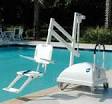
Basically, a pool lift is any mechanized seat with the ability to lower and raise a disabled or injured person into and out of a swimming pool. Pool lifts can either be permanent or portable. Permanent pool lifts can be installed on the edge of a pool, or onto an anchor embedded in the pool deck, while portable lifts, which usually have wheel attachments, can be placed anywhere around the pool, and then put in storage when not in use.

As with any type of product, different types of pool lifts have their own advantages and disadvantages. For example, permanent pool lifts are preferable in instances where the individuals needing them are heavier than normal, but, unlike portable lifts, they are always open to the elements.

The first commercially successful water-powered, swimming pool lift hit the market around 1980. By 1997, manufacturers had perfected a battery-powered, free-standing pool lift that was designed to work with more contemporary swimming pool designs. All types of patient lift systems, including pool lifts, are regulated by the U.S. Food and Drug Administration and must meet certain standards in their design and manufacture.

Swimming pool lifts can be categorized as follows: • Non –cantilevered lifts have seats that are attached to and rotate around an anchor point. Most early lifts were of this type as they are limited to simple pool designs that feature either no gutter of recessed gutters. They are fairly inexpensive and easy to operate, but they must be fixed in place to a deck or anchor and connected to a water supply to power them.
• Cantilevered lifts are designed to allow the seat to extend out from the anchor point. They can be fixed, anchored or free standing. Cantilevered lifts provide access to a greater number of pool designs, including rim-flow gutters, roll out gutters, or any type of design where there is a substantial horizontal distance from the loading point to the water. They are further categorized as non-rotational and rotational: o Non-rotational cantilevered lifts extend the seat directly out from the loading point.
o Rotational cantilevered lifts have the added ability to raise and rotate the seat position over the pool deck and extend it over any obstacle in the path to the water. This type of lift provides the greatest versatility of any of the different designs. They can be anchored or free standing, with free standing models generally the most expensive.

Pool lifts in public pools are regulated by the American with Disabilities Act, and as such, cannot be manually operated, as the law requires that they be capable of unassisted operation. However, manually operated pool lifts can be used in a residential setting.

Pacific Mobility has many pool lift options to choose from. We invite you to talk to one of our professional staff members who will help you determine what kind of pool lift best suits your needs and budget. Call us today for a free consultation.

Jeff Conner
Jeff Conner

President, Husband, Father, Grandfather Graduate of UC Davis- Bio Sci Major- Go Aggies! Jeff has extensive experience in all of Pacific Mobility’s products and services, and specializes in accessibility products as well as stairlifts, ceiling lifts and custom wheel chairs. His hobbies include spending time with family, gardening, mountain biking, exercising and off road motorcycle riding.

24 years as Owner/President of Pacific Mobility Center – selling, installing, and servicing stairlifts, porch lifts, ceiling lifts, pool lifts, handicap ramping, specialty wheelchairs, scooters, power wheel chairs, and other power mobility devices
Certified Environmental Access Consultant since 2008
Licensed General Contractor since 1998
Certified Aging in Place Specialist since 2016
Board Member for Home Access Professionals
Member of Association of Members of the Accessibility Equipment Industry (AEMA)

www.linkedin.com/in/jeff-conner-14085616/

Filed Under: Blog Posts, Product Information Tagged With: disability, mobility assistive equipment, mobility challenged, pool lifts

Hand Rail Systems Can Make the Home More Safe

October 19, 2015 By Jeff Conner

While many seniors prefer to live in their homes for as long as possible, most homes are not designed for maximum safety. As people age, their balance, stability and muscle strength tend to wane. This diminishing vitality, coupled with a concomitant decrease in visual acuity, is the cause of many home accidents. Indeed, falls are the number one cause of injury among seniors, responsible for almost three million emergency room visits and more than 25,000 deaths in Canada and the U.S., annually.

One type of home modification that can help make the home safer is a handrail system. There are three major reasons to install handrails:
• To support walking
• To support overall mobility
• To prevent falls

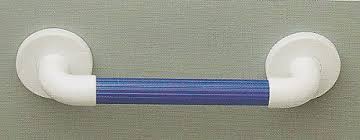
It is important to understand that railings and banisters are not handrails and should not be confused with them. Railings and banisters may provide some support, but they are generally not strong enough to prevent a fall should a person grab onto it in extremis. A true handrail must withstand at least 500 pounds of force.

In addition, according to the Americans with Disabilities Act, a handrail needs to be:
• 1¼” – 2″ in diameter
• Round (or equivalent)
• 1½” minimum from the wall
• At least 1½” above any horizontal protrusion
• Continuous on and between stairs, ramps, landings and horizontal extensions at the tops and bottoms of slopes

Handrails can be installed in many different areas of a house. For example, a handrail can be installed on the wall above the bath tub; in a shower or just outside it; next to a sink or toilet; alongside a bed; on a staircase; in a kitchen or work space, or anywhere else where a senior or anyone else who is mobility challenged, requires or desires one. Usually, they are made of metal, such as aluminum, but they can also be made of wood or heavy plastic.

More important than the actual handrail material is the strength of the bracket that attaches it to the wall.Therefore, it is highly advisable that handrail systems be installed by professionals using the appropriate fasteners and fixtures. Do-it-yourself installations may also be available, but instructions must be followed carefully when putting them up. Also, there may be cases where handrails would impede movement or create risks for the elderly if they are installed in an inappropriate location.

At Pacific Mobility, we can assist you in planning the best and most appropriate type of handrail system for your home. Our experienced staff can also install your handrails, providing you the best in safety and reliability.

Jeff Conner
Jeff Conner

President, Husband, Father, Grandfather Graduate of UC Davis- Bio Sci Major- Go Aggies! Jeff has extensive experience in all of Pacific Mobility’s products and services, and specializes in accessibility products as well as stairlifts, ceiling lifts and custom wheel chairs. His hobbies include spending time with family, gardening, mountain biking, exercising and off road motorcycle riding.

24 years as Owner/President of Pacific Mobility Center – selling, installing, and servicing stairlifts, porch lifts, ceiling lifts, pool lifts, handicap ramping, specialty wheelchairs, scooters, power wheel chairs, and other power mobility devices
Certified Environmental Access Consultant since 2008
Licensed General Contractor since 1998
Certified Aging in Place Specialist since 2016
Board Member for Home Access Professionals
Member of Association of Members of the Accessibility Equipment Industry (AEMA)

www.linkedin.com/in/jeff-conner-14085616/

Filed Under: Blog Posts, Product Information Tagged With: bathroom, crutches, disability, grab rails, mobility, mobility challenged, safety, senior citizens

Knee Walker vs. Crutches – Pros and Cons

September 30, 2015 By Jeff Conner

If you had to choose between using a knee walker versus using crutches after recovering from a broken ankle, foot surgery, or any other operation or injury, you might wish you had the option to choose neither. After all, any assistive mobility device is going to be something that you’re going to have to learn to control and maneuver, not to mention drag around. Of course, choosing neither is an option if you have the time and ability to stay completely off your feet for an extended period of time. However, most people want and need to be able to get around, and the thought of being totally immobilized until well enough to walk unassisted is far from a pleasant thought.

And so, these two devices are really your best choices. Let’s consider their pros and cons:

• Crutches – the Pros: If you have decent upper body strength and mobility, you can usually walk faster with crutches, once you’ve figured out how to use them. Also, walking with crutches will certainly take some work, and there’s nothing wrong with getting some exercise when recuperating from an operation or injury. Also, crutches are fairly inexpensive. You can even rent them from a medical supplier.

• Crutches – the Cons: Crutches can be difficult to maneuver. And because all your weight must be carried on your armpits, you certainly risk irritating them – not to mention the wear and tear on your shoulders, wrists and lower back. Many people with injured legs find crutches too unsteady and unsafe for their use. Also, when your arms and hands are occupied clutching your crutches, you will have more difficulty in using them to open doors, pick things up, etc. Stairs can be particularly difficult to navigate with crutches, especially at the beginning. Finally, crutches are clunky items that are constantly falling over and don’t always fit through doorways, car doors, etc.

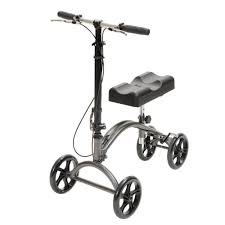
• Knee Walkers – the Pros: Knee walkers, because they are low to the floor are generally more stable than crutches. They are cushioned for comfort with space to let you rest a cast or injured leg, without having to put your weight on it. You can zoom around pretty quickly, once you get the steering figured out, and once you stop, you have both hands free. They are fairly simple to use and don’t require any upper body strength. They are less clunky than crutches and the possibility of slipping on slick or wet surfaces is diminished.

• Knee Walkers – the Cons: Knee walkers can be unstable if you lean back or forward too far or too much to one side. Also, they take a while to learn how to go straight. They are slower going than crutches on many surfaces. You cannot go up or down stairs on a knee walker, and if the front wheel base is too wide, you may not be able to go through narrow doorways or halls. Knee walkers are more expensive than crutches.

At Pacific Mobility, we can help you choose the best option for your post-operative or post-injury recovery. We will only sell you what you need, and within your budget, to help you get back on your feet in the quickest time possible. Call us today for a free consultation.

Jeff Conner
Jeff Conner

President, Husband, Father, Grandfather Graduate of UC Davis- Bio Sci Major- Go Aggies! Jeff has extensive experience in all of Pacific Mobility’s products and services, and specializes in accessibility products as well as stairlifts, ceiling lifts and custom wheel chairs. His hobbies include spending time with family, gardening, mountain biking, exercising and off road motorcycle riding.

24 years as Owner/President of Pacific Mobility Center – selling, installing, and servicing stairlifts, porch lifts, ceiling lifts, pool lifts, handicap ramping, specialty wheelchairs, scooters, power wheel chairs, and other power mobility devices
Certified Environmental Access Consultant since 2008
Licensed General Contractor since 1998
Certified Aging in Place Specialist since 2016
Board Member for Home Access Professionals
Member of Association of Members of the Accessibility Equipment Industry (AEMA)

www.linkedin.com/in/jeff-conner-14085616/

Filed Under: Blog Posts, Product Information Tagged With: crutches, disability, knee walker, mobility assistive equipment, mobility challenged

Staying in the Home You Love vs. Moving to Assisted Living

September 18, 2015 By Jeff Conner

Most seniors, if given the choice, would choose to remain in their own home for as long as possible rather than move to an assisted living facility. In fact, one study puts the number as high as 90 percent. This is not a mystery. For most of us – seniors included – home is where we’re comfortable; where it’s safe and familiar. We get to sleep in our own bed, eat what and when we like, and have a certain amount of privacy.

By and large, an elderly person who remains at home has a greater measure of independence than a contemporary who lives in an assisted living situation and giving up one’s independence can be difficult. In fact, for some seniors, transitioning to an assisted living community can be psychologically devastating, as it portends the end of one of life’s chapters, and the beginning of an unknown experience out of one’s comfort zone.

However, some seniors who do choose to remain at home may experience social isolation and poor nutrition which can contribute to cognitive decline, health problems, depression, and a diminished quality of life – especially if some of the activities of daily living (ADLs), like dressing, bathing, cooking, cleaning, going up and down stairs, etc. become too difficult. These seniors must come to terms with the situation that is facing them. Either they can stay in the home they love, or they can make the move to assisted living.

Luckily, today, more and more seniors have the option of “aging in place,” as long as they are willing to make certain modifications in the way they live and to the houses in which they live.

For example, even if one is not completely healthy, with home-healthcare, seniors can have their medical needs attended to most satisfactorily without having to leave home. In fact, one study found that those seniors who received in-home care visited the doctor 25 percent fewer times than those that didn’t receive in-home care. Clients with Alzheimer’s or other dementia diseases made almost 50 percent less trips to the doctor. In addition, other in-home services such as housecleaning, non-medical care, shopping, transportation, and food services can help offset the need for an elderly individual to have to struggle with common, everyday chores.

Making the home more “senior-safe” is another tactic that will allow an elderly individual to remain longer in the home he or she loves. Some general home alterations include the widening of doorways, and the installation of grab bars in the bathroom and/or shower, bed rails, and some type of stairlift in homes that contain more than one story. For seniors restricted to a wheel chair, an outdoor ramp or porch lift can enable them go in and out safely and at will. In addition, home monitoring equipment can let family members keep an eye on an aged loved one from a distance.

None of this should suggest that a transfer to assisted living can’t be a viable option for some seniors. There are certainly some advantages for the elderly individual whose needs – both medical and mundane – can be attended to in a professionally operated assisted living facility staffed by competent and caring people. However, for those seniors who wish to stay at home, and know the necessary modifications that are available, aging in place is certainly easier to accomplish now than ever before.

At Pacific Mobility, we are the aging in place experts. Our staff has the knowledge and experience to help you design and implement your home modifications so that you can continue to remain in the home you love for as long as possible. Call us today for a free consultation.

Jeff Conner
Jeff Conner

President, Husband, Father, Grandfather Graduate of UC Davis- Bio Sci Major- Go Aggies! Jeff has extensive experience in all of Pacific Mobility’s products and services, and specializes in accessibility products as well as stairlifts, ceiling lifts and custom wheel chairs. His hobbies include spending time with family, gardening, mountain biking, exercising and off road motorcycle riding.

24 years as Owner/President of Pacific Mobility Center – selling, installing, and servicing stairlifts, porch lifts, ceiling lifts, pool lifts, handicap ramping, specialty wheelchairs, scooters, power wheel chairs, and other power mobility devices
Certified Environmental Access Consultant since 2008
Licensed General Contractor since 1998
Certified Aging in Place Specialist since 2016
Board Member for Home Access Professionals
Member of Association of Members of the Accessibility Equipment Industry (AEMA)

www.linkedin.com/in/jeff-conner-14085616/

Filed Under: Blog Posts, Product Information Tagged With: bathroom, disability, grab bars, grab rails, mobility, mobility challenged, safety, senior citizens

Making Bathrooms Safe for Seniors

August 1, 2015 By Jeff Conner

We like to think that our bathrooms are safe and private places – places where accidents don’t generally happen. But it doesn’t take a lot for a bathroom to become a dangerous place for a frail or elderly senior. According to a recent study from the U.S. Centers for Disease Control and Prevention (CDC), nearly 200,000 Americans are treated in hospital emergency rooms, every year, for bathroom-related injuries. And since more than one in three persons over 65 fall each year, it’s safe to say that many of those who receive emergency treatment are elderly.

By and large, bathrooms have many hard and slippery surfaces, making them especially hazardous for individuals with mobility challenges, such as poor muscle strength or bad balance. But before one can make bathroom trouble spots safer for seniors, it’s important to know where and how bathroom accidents occur. Most bathroom falls occur while getting in and out of the tub or shower; sitting down and getting up from the toilet; and walking while attempting to use towel bars, sink tops, or other objects for support.

The first modification that can be made in a shower is getting rid of any lip that has to be stepped over getting in or out. If possible, a traditional shower stall can be replaced with a walk-in model. If that is not possible, or even if it is, grab bars should also be installed close to the shower opening to supply balance support. Another bar, or set of bars, should be installed in the shower, as well. A shower chair is an easy fix to supply stability as well as a place to rest for a senior who can’t stand for long periods. Another way to modify a shower for safety is to install a hand-held shower head with a long enough hose so that its user doesn’t have to stretch or bend.

Getting in and out of a bathtub can be very difficult for a frail senior. Here, again, well-placed grab bars can be helpful. For floor to tub transfers, a bath bench is another modification that can promote safety. Two of the bench’s legs are placed outside of the tub and the other two, within it. The user sits on the bench and swings his or her legs over the side, and then slides into the tub, without having to stand up. Of course, for both tubs and showers, non-slip mats are necessary inside, and non-slip rugs should be placed on the outside.

Toilets are another potential trouble spot, but there are several modifications that can be made. Raising the toilet seat several inches reduces the need to squat and the distance that has to be covered. Additional safety features include brackets or locking clamps that stabilize the seat on the toilet rim. Also, grab bars can be attached either to the wall near the toilet, or to the toilet, itself.

Of course, bathrooms should be well-lit, with towels, soap, and toiletries within easy reach. All surfaces, walls and floors, included, should be clean and free of any soap scum that makes them more slippery. Finally, the bathroom should be as free as possible of any fragile items or those that can fall and break.

At Pacific Mobility we provide all of the necessary safety items and equipment that can help make your bathroom safe for seniors. We can also help you make the best choices for any extensive bathroom modifications that you might wish to make. Call or visit us today.

Jeff Conner
Jeff Conner

President, Husband, Father, Grandfather Graduate of UC Davis- Bio Sci Major- Go Aggies! Jeff has extensive experience in all of Pacific Mobility’s products and services, and specializes in accessibility products as well as stairlifts, ceiling lifts and custom wheel chairs. His hobbies include spending time with family, gardening, mountain biking, exercising and off road motorcycle riding.

24 years as Owner/President of Pacific Mobility Center – selling, installing, and servicing stairlifts, porch lifts, ceiling lifts, pool lifts, handicap ramping, specialty wheelchairs, scooters, power wheel chairs, and other power mobility devices
Certified Environmental Access Consultant since 2008
Licensed General Contractor since 1998
Certified Aging in Place Specialist since 2016
Board Member for Home Access Professionals
Member of Association of Members of the Accessibility Equipment Industry (AEMA)

www.linkedin.com/in/jeff-conner-14085616/

Filed Under: Blog Posts, How To's Tagged With: bathroom, elderly, grab bars, grab rails, mobility, mobility challenged, safety, senior citizens

Getting in and Out of a Vehicle

July 10, 2015 By Jeff Conner

Many mobility-challenged people still need, or prefer, to be able to travel by car or truck either as a driver or a passenger. Luckily, the art and science of vehicle conversion has come a long way in recent years and these individuals have a wide range of choices when it comes outfitting an automobile, truck, or van with the necessary accommodations.

Picking both the right type of vehicle and the best kind of conversion depends on many factors. Perhaps the most important is determining the nature and extent of someone’s mobility challenges. Some disabled drivers who are able to get around without a wheelchair may also be able to get by with less than a fully-converted, wheelchair-accessible van. For these individuals, simply purchasing a sedan or coupe with a low and accessible seat height may be sufficient.

However, individuals with greater mobility challenges should definitely consider a vehicle equipped with seating that allows safe and easy access and egress. Several types are available. A turnout chair provides trouble-free access to vehicles that are lower to the ground. The seat rotates about 90 degrees and slides out a few inches over the doorsill. Once it is occupied it can be moved back to its original interior position for travel. Reversing the procedure allows a driver or passenger to exit the vehicle, safely. A turnout seat can be either manually or electronically controlled.

The next level up in this department is a turnout seat that not only rotates, but also can recline slightly for extra headroom, while it lowers toward the ground, just outside the car. Finally, there are rotating chairs that can come completely out of a vehicle and then lower towards the ground. They, too, can be electronically controlled either with a hand control unit, or power buttons installed within the seat or car door.

Other adaptation options include wheelchair lifts, hand controls, and mechanized lifts, called “curbsiders,” that can be fitted into the rear of a truck or van in order to load or unload a motorized scooter.

Before considering what type of vehicle adaptation is the right one for you, you should always consult an expert in the field. Here at Pacific Mobility we have the experience and expertise to help you select the most appropriate conversion or adaptation for your mobility challenges that will both suit your needs and fit within your budget. Call us today for a free consultation.

https://youtu.be/ajy2TH0b7OY

Jeff Conner
Jeff Conner

President, Husband, Father, Grandfather Graduate of UC Davis- Bio Sci Major- Go Aggies! Jeff has extensive experience in all of Pacific Mobility’s products and services, and specializes in accessibility products as well as stairlifts, ceiling lifts and custom wheel chairs. His hobbies include spending time with family, gardening, mountain biking, exercising and off road motorcycle riding.

24 years as Owner/President of Pacific Mobility Center – selling, installing, and servicing stairlifts, porch lifts, ceiling lifts, pool lifts, handicap ramping, specialty wheelchairs, scooters, power wheel chairs, and other power mobility devices
Certified Environmental Access Consultant since 2008
Licensed General Contractor since 1998
Certified Aging in Place Specialist since 2016
Board Member for Home Access Professionals
Member of Association of Members of the Accessibility Equipment Industry (AEMA)

www.linkedin.com/in/jeff-conner-14085616/

Filed Under: Blog Posts Tagged With: auto hand controls, disability, driving, mobility assistive equipment, mobility challenged

Pros and Cons of stairlift Installations

March 29, 2015 By Jeff Conner

There’s no doubt that the technology of the modern stairlift has provided seniors, as well as other individuals with mobility challenges, more choices than were available to previous generations. And for the most part, the benefits of having a stairlift in one’s home outnumber their potential shortcomings. But the prudent consumer should always contemplate both the pros and cons of any purchase in order to make the wisest decision possible. So here are a few things to ponder:

The Pros

If you are a senior who can no longer navigate the stairs, the main reason to have a stairlift installed in your home is because it allows you to stay in your home long after your ability to go up and down the stairs has ended. Most seniors will tell you that staying at home, as opposed to transitioning to senior housing or assisted living, is extremely important to them, as it allows them to remain independent in the most emotionally supportive environment possible.

A stairlift is an accident preventer. The statistics are unambiguous – accidental falls, especially on stairs, are the number one cause of harm to seniors. stairlifts remove the potential for serious and even fatal blunders that can put an elderly person in the hospital, or worse.

stairlifts can carry both people and things. Generations ago, multistory houses had dumbwaiters which allowed for the transport of food, laundry, etc. from floor to floor. The stairlift can easily perform a similar role, as long as the intended object can fit on one’s lap.

For the relatives of seniors or any other individual with mobility challenges, a stairlift can provide piece of mind. Just knowing, for example, that an elderly parent no longer has to try and navigate stairs, can help relieve children of excess worry and concern.

The Cons

Probably the biggest concern that a consumer will have when contemplating the installation of a stairlift, is the cost. A quality lift, plus the installation itself, will run several thousand dollars. For some, that is a potential deal breaker. On the plus side, you might qualify for a medical expense tax deduction and/or the possibility of zero percent financing for up to 18 months.

Another concern: While most homes today have stairways that are wide enough to accommodate a stairlift without any issues, some older homes may have a very narrow stairway, and this is why having a professional assess the home is so important. Also, sometimes a person may have physical limitations in how he or she can sit in a stairlift chair. For example wearing a full leg cast that would cause one to to have to extend a leg may make it impossible to fit in the stairway, while sitting.

Finally, some believe that the installation of a stairlift too soon may create a dependency upon it by an otherwise healthy individual who would still benefit from the exercise of going up and down stairs. This seems a minor concern, as there are many ways in which a mobile senior can still find outlets for physical activity.

At Pacific Mobility, we will never sell or install a stairlift unless it is the right choice for you, your family, your home and your budget. Knowing the pros and cons will help you determine if a stairlift is the best option for you.

https://youtu.be/8s4EkLnQu8Q

Jeff Conner
Jeff Conner

President, Husband, Father, Grandfather Graduate of UC Davis- Bio Sci Major- Go Aggies! Jeff has extensive experience in all of Pacific Mobility’s products and services, and specializes in accessibility products as well as stairlifts, ceiling lifts and custom wheel chairs. His hobbies include spending time with family, gardening, mountain biking, exercising and off road motorcycle riding.

24 years as Owner/President of Pacific Mobility Center – selling, installing, and servicing stairlifts, porch lifts, ceiling lifts, pool lifts, handicap ramping, specialty wheelchairs, scooters, power wheel chairs, and other power mobility devices
Certified Environmental Access Consultant since 2008
Licensed General Contractor since 1998
Certified Aging in Place Specialist since 2016
Board Member for Home Access Professionals
Member of Association of Members of the Accessibility Equipment Industry (AEMA)

www.linkedin.com/in/jeff-conner-14085616/

Filed Under: Blog Posts Tagged With: mobility, mobility challenged, stairlift

  • « Go to Previous Page
  • Page 1
  • Interim pages omitted …
  • Page 8
  • Page 9
  • Page 10
  • Page 11
  • Go to Next Page »

Footer

San Diego County Showroom

1355 Grand Ave Suite 102
San Marcos, CA 92078
Toll Free: 866-786-2966
Local: 760-471-8884

Riverside County Lift Sales

Pacific Mobility Center of Temecula
Toll Free: 866-786-2966
Local: 951-383-6845

Orange County Lift Sales

Pacific Mobility Center of Huntington Beach
Toll Free: 866-786-2966
Local: 714-907-4005

Office Hours

Monday-Thursday: 9:00am-5:00pm (closed 12:00-1:15 for lunch)

Friday: 8:30am-4:30pm (closed 12:00-1:15 for lunch)

Find Us on Social Media

Facebook Yelp BBB Angies List Twitter LinkedIn

Showroom Location


View Larger Map

  • Home
  • Coupons
  • Quote Request
  • About Us
  • Products
  • Careers
  • Blog
  • Gallery
  • FAQ
  • Contact
  • Service Area
  • Privacy Policy
  • Terms of Service
  • Disclaimer
  • Cookie Policy
  • Proposition 65 Warnings

Copyright © 2026 Pacific Mobility, All Rights Reserved.


Website by A Servant's Heart Web Design and Marketing

Schedule an Appointment

How can we help you?